Take the next step.

Request a quote for our quality-assured analysis and sampling services, and we will get back to you in the next couple of business days.

Regulation 61: How ALS can Support Testing Requirements for PFAS


Regulation 61 notices have been served to many airports across the UK under the Environmental Permitting Regulations 2016. These have been specifically focused on per-and-polyfluoroalkyl substances (PFAS) and a range of other potential pollutants which may include hydrocarbons, pesticides, herbicides, ammonia, biological oxygen demand, and other inorganic and organic parameters.

With any new regulation, it is always advisable to partner with a reputable laboratory that can help you ensure compliance for yourself or your end- client. You can rely on with an experienced technical and client-facing teams, who are familiar with the requirements of these notices and can support you in understanding permit requirements.

PFAS Requirements

Per- and polyfluoroalkyl substances (PFAS) have become a major focus of worldwide concern including here in the UK. PFAS are a group of active constituents in aqueous film forming foams (AFFF). Because of the extensive historic use of AFFF at airport sites, during emergency response and training, there is a requirement to analyse discharges to determine concentrations of PFAS. As our understanding of the presence, toxicity, and potential effects of this group of emerging contaminants continues to advance, the demands for PFAS analysis continues to increase. ALS remains one of the global leaders in this field and is responding to the changing regulatory and analytical requirements of PFAS testing.

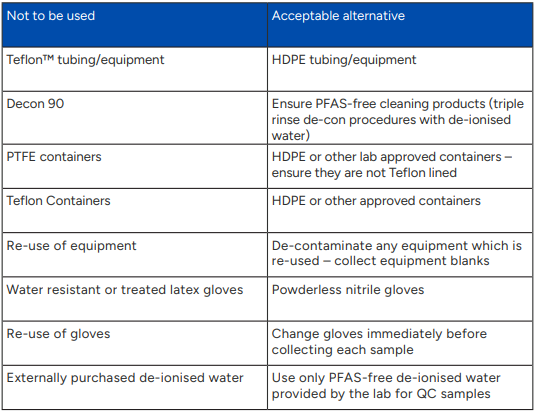
Below is a summary of items that are likely to contain PFAS and therefore should not be used by staff conducting sampling and some acceptable substitutions.


Sampling Requirements and Laboratory Analysis

ALS now offer the following suite (TM 434), which is fully compliant with the requirements of Annex I of Regulation 61 notice. Please download our flyer to view the full PFAS broad suite. 

Samples are extracted using solid phase extraction (SPE) and analysed by liquid chromatography coupled with a triple quadrupole mass spectrometer (LC-MS/MS).

Samples should be collected using digitubes which help to minimise effects from analyte sorption on sample containers, as analysis is carried out of the entire sample including the container rinsate. We offer sampling guidance documents to support your sampling and can provide technical support at every step of the process.

This rendering failed. Please review the data contents.